Historic Harlem Court House

The Harlem Community Justice Center's Reentry Services are located in East Harlem

2013 Reentry Graduation starts with a song

The choir started off the celebration this year at the Reentry Court Graduation

Family Reentry Summer Celebration

During the summer, we host a block party and celebration for Reentry clients and their families

Reentry Graduation

Young man thanks his Parole Officer for keeping him on track

Harlem Reentry Graduation

Families join to celebrate the accomplishments of graduates

Showing posts with label Parole. Show all posts

Nov 28, 2011

NJ Expands Reentry Efforts

Today, as reported in North Jersey.com, NJ's Governor, Chris Christie, is expected to announce a major expansion of the state's reentry efforts. "The initiative adopts many of the recommendations made to the Christie administration by the Manhattan Institute, a conservative New York City-based think tank with a progressive reputation on prison issues, which was commissioned to analyze the state’s current prisoner re-entry system.
The institute found the state’s existing re-entry efforts amounted to 'a confusing system with no centralized definitions and mission, a lack of accountability for outcomes . . . and a lack of coordination, with potential duplication of services and no continuity between services provided in prison, during parole and in the community.'”

The Governor’s first major criminal justice initiative calls for:


"Expanding the state’s Drug Court program, which allows those convicted of certain non-violent drug offenses to bypass incarceration by agreeing to a strict regimen of court appearances and drug or alcohol treatment and other recovery services to break the addiction.

The creation of the Task Force for Recidivism Reduction, which will be co-chaired by attorney Lisa Puglisi, with the state Department of Corrections and the State Parole Board, and James Plousis, chairman of the State Parole Board. The task force will coordinate the many treatment and reentry programs across the state government to bolster reentry efforts, as well as make recommendations to the governor on how to improve those programs.

The task force will also assess the effectiveness of all reentry programs currently offered using a real-time recidivism database, which will allow officials to track individuals and the success of the programs they participate in. Using the data, the task force will identify programs that fail and suggest how resources could be better spent to improve recidivism rates."

Oct 6, 2011

Are Parole Supervision agencies using practices grounded in evidence?

The Urban Institute recently released the results of their findings from a 2008 Parole Practices Survey that explores the use of evidenced based practices in the supervision of individuals on parole. According to the recent publication, Surveying the Field,  the survey results produced four key findings: 1)Widespread use of evidence-based practices (ebps)and many components of effective paroles supervision were reported; 2)Uncertaintly was common in the parole field regarding the definition of "evidenced-based practices"; 3)Many parole field offices do not know whether parolee recidivism is being tracked (suggesting that recidivism is not a key outcome for assessing field office performance in many states); and 4) Approaches to enhance parolee's motivation and engage the parolee's supports are not common in many states.

Although the results are mixed and various barriers exist to the implementation of evidenced based practices,  the developing focus on EPBs which target offender needs and risk, enhance intrinsic motivation, and engage pro-social supports in the client's community, is a new and exciting development that has the potential to transform the way parole is done (and, most importantly, to  reduce technical violations and recidivism). In New York State, for instance, DOCCS Community Supervision Staff (formerly known as Parole) is in the process of training staff on the COMPAS Assessment which assesses the needs and risk (both dynamic and static) of an individual being released from prison with the goal of providing enhanced supervision to those who are "high" risk, and less risk to those who are at the lower end of the risk spectrum.  The COMPAS Assessment also gives parole and reentry providers information on which of the needs and risk of the individual are greatest, and therefore should be focused upon. For more information on incorporating evidenced based reentry practices into community supervision and reentry programs, take a look at the publication, Implementing Evidence-Based Practices published by the Center for Effective Public Policy.

Nov 1, 2010

Operation Halloween Keeps Kids Safe

If there was every an argument for how the State’s Division of Parole helps to keep communities safe it can be found in today’s Daily News. The article profiles two dedicated parole officers who spent their Halloween visiting known sex offenders in Bushwick Brooklyn. According to the article, sex offenders cannot display Halloween decorations, and must be indoors and cannot answer their doors between and Halloween night.


Aug 5, 2010

Understanding Parole Revocations: My Interview with Parole Revocation Specialist, Elaine Kallinikos


The New York State Division of Criminal Justice Services recently released its 2009 Crimestat Report which included the rates of return to prison for formerly incarcerated individuals over the period of three years, beginning in 2006 and ending in 2009. In 2006, 24,520 individuals were released from NY State prisons. After three years of release, 41.2 %of them had returned to prison. While many may assume that most individuals on parole return to prison because they have committed a new offense, the vast majority are actually sentenced to a term of prison due to a violation of the conditions of their parole. In fact, between 2006 and 2009 only 10.7% of released individuals returned to prison because they were convicted of a new felony offense. The vast majority, 30.5%, were returned to prison due to a violation of the conditions of their parole or what is referred to as a “technical violation.” A technical violation occurs when an individual on parole fails to abide by the rules set out for him by the Parole Board at the time of release. These include, reporting to a Parole Officer, abiding by a curfew, refraining from associating with others on Parole, and staying off drugs, to name a few.

To learn more about what happens when someone is taken into custody for a technical violation of parole, I sat down with Elaine Kallinikos, a Parole Revocation Specialist for the New York State Division of Parole, Manhattan Six, Special Offenders Unit. Ms. Kallinikos is responsible for prosecuting parolees serving a term of parole after a conviction for a sex offense, parolees who have a mental illness, or parolees involved in a special reentry program (including the Reentry Programs at the Harlem Community Justice Center) when they are accused of violating the conditions of their parole. Ms. Kallinikos prosecutes these individuals in front of an Administrative Law Judge at what is called a “Parole Revocation Hearing.”


What is a parole revocation hearing and what is your role in that hearing?

When a Senior Parole Officer makes the determination to issue a warrant for an individual because he has violated the conditions of his release, he is taken into custody and entitled to two hearings. The first is a preliminary hearing, the second is a final hearing. The preliminary hearing is to determine whether the Division of Parole had probable cause to issue a warrant for violating the conditions of his release. This preliminary hearing can be, and often is, waived. If the parolee decides to have the preliminary hearing, and the hearing officer determines that there was probable cause to issue the warrant, the parolee will remain in custody.

When the preliminary hearing is completed, the case is sent to me. We then have an arraignment process where I take the charges into consideration and may offer a plea. If the parolee pleads guilty his parole will be revoked and he can be sent back to prison or he may be “revoked and restored” and sentenced to a program in the community and continue on parole. Otherwise, he may have a contested hearing, a Parole Revocation Hearing, in which I bring witnesses to prove the charges and an attorney representing the parolee brings witnesses to dispute the charges.

How do you decide what type of sentence to recommend when someone accepts a plea or has a contested hearing and loses?

First, the law guides what type of sentence a parolee is eligible for. The first category is a “Category One” which means that the parolee is a “Violent Felony Offender” and he can face up to 15 months. The second, “Category Two Violators” are “Non-Violent Felony Offenders” and are eligible for programs. “Category Three Violators” are exempt from “Category Two” because they have some sort of psychiatric or medical exclusion. A “Category Four Violator” is a persistent violator, someone who has violated Parole more than two times. They can be sentenced up to 12 months.

The Revocation Specialists considers what category the parolee falls under as well as a range of other factors: whether or not this is the individual’s first parole violation, his criminal history, if he turned himself in or if he absconded. We look at whether the individual has a drug condition, whether he suffers from a mental illness, and whether he has had an opportunity for programming before. Individuals may also violate on different phases on parole. Some may have never made their arrival report so there has never been any adjustment to supervision. Some may have just relapsed from drugs or many have decompensated mentally.

for clarification, can you take me through a scenario, one that includes a new misdemeanor offense and some technical violations? An individual is on parole for a non-violent offense, a drug sale. He is accused of shoplifting at 12am (past their curfew), arrested by the police, and brought into criminal court. What happens?


First, just because an individual is arrested on parole doesn’t mean he is going to be violated by his Senior Parole Officer. The Parole Officer must do a thorough investigation. He must speak to witnesses--police officer, store security, a complaining witness—and based upon that, make a determination as to whether there is enough evidence to sustain a charge. In this scenario, there are three potential “technical charges” that the individual can be violated for. I am not referring to the new separate criminal case that will be taken care of separately. The “technical charges” are having broken the law, staying out past curfew, and possibly not reporting police contact to his Parole Officer

Cases are conferenced between the Parole Officer and the Senior Parole Officer and it is determined whether it is necessary to issue a warrant because either the individuals is a danger to community, himself, or he is in violation of his parole conditions. Alternatives to incarceration at that juncture are deemed inappropriate. Not to say that they may not be considered later on in the process, but at the point that the individual is taken into custody, generally, all other alternatives should have been exhausted and sanctions should have been imposed.

So if the Senior Parole Officer decides to issue the warrant, the parolee is taken into custody, and held on Riker’s Island [one of New York City’s jails]. A preliminary hearing must occur within 15 days from which the warrant is lodged. If the parolee waives the preliminary hearing, he must have a final hearing within 8 business days of the lodge of the warrant.

Who presides over these hearings?

The preliminary hearing determination (of probable cause) is made by hearing officers. Hearing Officers do not have law degrees. (Who are they employed by?)

The State Division of Parole.

The arraignments and final hearing are presided over by an Administrative Law Judge (ALJ). At these proceedings, I make my recommendation, the parolee’s attorney makes his and in non-board [Parole Board] reviewable cases, the ALJ’s decision is final.

What is the difference between Board-Reviewable cases and Non-Board Reviewable cases?

Board Reviewable Cases are cases where the individual who is being adjudicated for a technical violation is a violent felony offender. For example, a sex offender or someone who has committed a homicide. For example, you have someone on parole for rape and it is his first violation. Let’s say he has been out on parole a year and up until the point of the violation he was doing well. Let’s say what brought him back into custody was that he wasn’t attending his program and missed two reporting days. I make a recommendation, the parolee’s attorney makes a recommendation and the ALJ makes a decision. So for a sex offender first violation, if I recommend twelve months in prison and the Judge agrees with me, that case then goes to the Parole Board. The Board doesn’t have to go along with it. They can turn around and say they are going to give him more time [or less].

You work in the Special Offenders Unit. so you prosecute people with mental illnesses who I imagine have more difficulty complying with the rules of parole. How do you think about this when making your recommendation to the judge or Parole Board?

I do find that people with mental illness do have more difficulty complying with the rules. Hopefully, at the point in which that individual is brought to their final hearing, they are stabilized on medication.

The parolee’s attorney will offer mitigation regarding their mental health issue and why they were violating their condition of parole. I may argue that even though the client was mentally ill, they still understood that they had to abide by conditions of a release or that at the time they were violated they were stable.

The judge will make the determination. If the individual has committed a violent act, for which they have been violated, generally that will go to a contested hearing and then I will have to bring victims to testify. If it is just a matter of technical violation and they don’t believe the individual is a danger to community, that individual will generally end up in a program. Sometimes, I may argue that I feel the individual is a danger to the community. I may point that out to the judge, but it’s the judge’s decision. If the person is sentenced to a program, the person waits in jail until they find a program—a lot of the mentally ill individuals will be waiting in jail because there is a lot of paperwork that need to be approved.

We hear a lot about being indeterminate sentences such as “fifteen to life.” Does anyone ever serve a life sentence on parole?


“Life” is not life as we know it. Individuals who receive a life sentence are eligible for discharge from parole after 3 years. The Parole Officer submits a report to the Board for consideration. This is only their recommendation. The Parole Board makes a final decision. Individuals who have life on parole that keep on violating their parole can wind up on parole for life. They make their “life sentence” a life sentence because they keep getting technical violations and lose time.

A few questions about you. What do you like about your work?

I feel that I make a difference, that I am protecting a community. I felt like that as a Parole Officer and as a Senior Parole Officer. We work very hard and I just want to impress that it is not all about sending these guys back to prison. What sends them back to prison is their behavior and our main concern is the protection of the community. Sometimes it may be in the best interest of the community for that individual to reenter society with the supports that he needs and that is also what we try to do in the violation process as well. It’s a balance. It is not just about sending everyone back, it is also about helping them to make a successful reentry into the community.

What is your day to day like?

When I am in the office, I am preparing cases, speaking with Parole Officers, doing investigations, and speaking with police officers, ADAs, Legal Aid attorneys. I am reading through databases; I want to know the history of how the guy came to violate his parole. That is basically what I do when I’m in the office.

When I am at court, I am presenting my cases, either conferencing cases or having contested hearings.

How often do you have contested hearings?

Infrequently, only because I work very hard to resolve the cases. I really save the fight for the fight.

Is there anything else you’d like to share about your work?

The Revocation Specialists work very hard and we are not a separate entity from our Parole Bureau. We do ask the Parole Officers for their recommendations and take them into consideration. It is very important for us to work together as a team. The bottom line is community safety. Even though our focus is on reentry, which is important, we should not lose sight of our mission. We should be focusing on reentry, but we should always keep the protection of the community in mind.

Jun 8, 2010

Division of Parole & Evidence Practices: "Parole Beyond All Limits"


Today I attended New York State Division of Parole’s Conference entitled “Parole Beyond All Limits: Rebuilding, Families, Communities and Individual Lives.” The conference included three panels, “Faith Based Community’s Response to Prisoner Reentry,” Strengthening the Family for Successful Family Unification,” and “Parole Beyond All Limits.”

The “Parole Beyond All Limits” panel focused on the future of parole in the state of New York and its transition towards evidence-based practices, which is a hallmark of the Transition from Prison to the Community model (TPC) that New York has adopted. With 86% of individuals leaving prison on parole, Steve Miller, Division of Parole, addressed the importance of using a model “based on research and documented findings” to assure the transformation from ex-offender to productive citizen. Among the new initiatives Mr. Miller highlighted are the following:

1) The use of the Transition from Prison model which uses a collaborative approach to maximize experience and resources
2) The introduction of COMPAS, an actuarial risk assessment tool that identifies the risk and needs of individuals being released from prison and indicates how to respond with a case management plan
3) The development of an online document that will follow an individual from incarceration through release called a Transitional Accountability Plan (TAP). This document will ensure communication between Parole and Department of Corrections, continuity of services, and reduce duplicative efforts.

Parole also introduced their new Graduated Response Decision Making Tool. This scheme, created in collaboration with the Vera Institute of Justice, helps Parole Officers determine how to respond swiftly and proportionately to behaviors that indicate a risk of reoffending. The guide recommends interventions that address the underlying cause of the behavior and are responsive to the level of risk of reoffending that the behavior signals. The graduated response tool has also formalized an incentive structure for positive behavior. Affirmation of positive behavior through the use of incentives has been shown to be crucial in promoting program compliance. ( Harrell, Cavanagh and Roman 1998)

Ms. Letricia McClearly, a Senior Parole Officer in Brooklyn outlined the scheme and commented on three of the findings of the study that she found notable.

1) The crime of conviction is not a strong predictor of the risk of reoffending. (Instead, the presence of criminogenic factors such as substance abuse, lack of employment/training, anti-social behavior, contributes to a likelihood of reoffending).
2) A long stay in a shelter greatly increases the likelihood of recidivism.
3) More contacts with individuals on parole are associated with increased technical violations.

While Ms. McCleary praised the hard work of Parole Officers (POs) she also acknowledged that Parole must look at the quality of interactions between parolees and their POs, ensure that POs are offered “education and training” to successfully implement the Division’s new approaches, and abandon the “cookie cutter approach” that leads to failure.

As the Taskforce continues working with Parole on our Pilot Case Management Program and at Harlem Community Justice Center’s Parole Reentry Court, we are excited to be piloting many of the evidence based practices described in the conference and reporting to you on our successes.

Jan 11, 2010

What works for parole violations?: "Swift, predictable, and moderate punishment."


The Sunday times article, Prisoners of Parole, describes some innovative approaches to reducing parole violations and gang violence. One program, Judge Alm's HOPE (Hawaii's Opportunity Probation with Enforcement) imposes immediate, moderate punishment for technical parole violations instead of allowing parolees to violate their conditions of parole a few times with no consequence followed by a harsh sanction such as jail time. The program's ethos is grounded in classical deterrence theory which offers the wisdom that: "the threat of a mild punishment imposed reliably and immediately has a much greater deterrent effect than the threat of a severe punishment that is delayed and uncertain." Such thinking may also underlie the increasing use of graduated sanctions for parolees who violate the technical conditions of their parole. (Check out Vera Institute for Justice and The Center for Court Innovation).


Why does "swift, predictable, and moderate" punishment work? The New York Times article points to recent studies in behavior economics: " [P]eople are more sensitive to the immediate than the slightly deferred future and focus more on how likely an outcome is than how bad it is," as well as Judge Alm's own revelations: “When the system isn’t consistent and predictable, when people are punished randomly, they think, My probation officer doesn’t like me, or, Someone’s prejudiced against me rather than seeing that everyone who breaks a rule is treated equally, in precisely the same way.”

Judge Alm's statements touch upon the relationship between a parolee's (or any defendant's) perception of procedural fairness and their compliance with a court sanction as well as their overall trust in the law. For more information on this critical and fascinating issue, take a look at Tom Tyler's groundbreaking work and the Red Hook Community Justice Center's Case Study.

Dec 19, 2009

Finding a Job: An Interesting Approach

A story in today's New York Times describes Michael Johnson's tactic for finding a job after having spent time in prison.

Although not required, he clips a note to any job application he submits, saying, "'I have been convicted of a nontheft, nonviolent felony over 11 years ago,' it reads. 'I take full responsibility for my actions and have succeeded in turning my life around. I understand the stigma that is attached with a felony and will make it my mission to prove that I am trustworthy, dependable and hard-working.'"

There's also an unexpected -- and charming -- romantic aspect to Mr. Johnson's story.

Sep 27, 2009

California's Parole Problems with Sex Offenders

Today's NY Times has a pretty good article about California's troubles managing paroled sex offenders (and parolees in general). As you may know, California's budget crisis has forced it to close a number of prison facilities and now large number of people will be released to parole supervision. Additionally, as the article notes, reentrants will not be sent back to prison for "technical violations" -- or those infractions that include missing your curfew, abusing alcohol or a controlled substance, failing to go to work -- as they have been in the past. Interestingly, this is actually good policy in general. The idea that people's addictions or curfew problems can be addressed with a community-based solution instead of more prison time has been tested by the Harlem Parole Reentry Court over the past ten years and the results have been positive in terms of reducing recidivism. Hopefully, California will be able to create statewide infrastructure that supports this kind of intervention. (Budget cuts are hurting everywhere -- take a look at this article about the elimination of financing for California's Domestic Violence Program. Also, Gov. Schwarzenegger recently enacted an 80 percent cut in Proposition 36, the state’s largest drug treatment diversion program)

Today's article does a really good job of laying out how difficult it is to parole people with sex offenses. There are logistical challenges like finding them a place to live -- nobody wants to live near or with a sex offender -- helping them maintain employment, and keeping an unpredictable surveillance operation going. On top of all this, most paroled sex offenders battle mental illnesses that promote their illegal behavior and many use drugs or alcohol to self-medicate. Although parole officers with this specialized caseload will see the number of people they supervise decrease from 70 to 45, it is an open question as to whether cuts to other key services (like drug treatment) will put these officers in even more of a bind.

Sep 2, 2009

Harry Belafonte Delivers Keynote Address to Graduates of Harlem Reentry Program

Yesterday the Harlem Parole Reentry Court held a graduation event to celebrate those parolees who have completed the six-month program. The Harlem Parole Reentry Court opened in 2001 with the goal of enhancing public safety and reducing recidivism among parolees returning to East and Central Harlem. The Reentry Court, a project of Center for Court Innovation in collaboration with the New York State Division of Parole, works with parolees during the first six months of their release to promote law-abiding behavior. The Reentry Court provides on-going judicial monitoring before an Administrative Law Judge, case management, linkages to critical services, and the use of graduated sanctions and rewards to respond to setbacks and achievements.


Last night was a very special graduation. To a packed room our keynote speaker the legendary Harry Belafonte, who was joined by his wife Julie, delivered a passionate and positive message of perseverance in the face of struggle. "I was born in Harlem and still live in Harlem", he said, as he described the many opportunities that came to him. He talked about his own personal story of returning from service at the end of WWII and honing his acting craft through the American Negro Theater in Harlem were he developed life long friendships with great actors like Ossie Davis, Ruby Dee and Sydney Poitier. He highlighted the many ways that the community “wrapped itself around him” in the form of the many mentors and friends he was privileged to know including Dr. King and Ma lcolm X.

He spoke about the plight of a five year–old African-American girl in Florida in March of 2007 who was handcuffed and arrested at school because she was “acting out.” After many years of fighting for human rights in America, he saw the plight of the Florida girl as a call to fight anew against the continued injustice of the American criminal justice system. Since 2007 he has led the development of The Gathering for Justice and committed himself to organizing around the problems faced by men and women who are in prison and gang involved.

The graduates, their families and guests left inspired!
To hear a podcast of the event click here

Sep 1, 2009

"Outbreaks Near Me"

You may have noticed that we're a little obsessed with technology, and especially the iPhone, at Rethinking Reentry.

It was hard to pass, therefore, on this story about a new iPhone application, called "Outbreaks Near Me." With all the hysteria about H1N1 (Swine Flu), this app provides users with a way of tracking outbreaks of the disease near them. Users can even upload "outbreak reports" with pictures and descriptions.

Creators at Children's Hospital Boston and the MIT Media Lab admit that the current version isn't able to weed out fake reports from real ones, but say that the tool has real potential if it is adopted among a wide swath of the population.

The thing we're pondering, of course, is whether this kind of application could have other uses, particularly in problem-solving justice. Putting aside the issue of access to technology for the moment (we are well aware that most reentrants don't have the means to acquire and maintain an expensive iPhone), of what use could this technology be in criminal justice circles?
  • What if employers could post jobs to the application (a "jobs outbreak!") and reentrants could find open positions and (more importantly) find employers friendly to people with criminal records?
  • What if parole officers could post their own reviews of local service providers for their colleagues to see? Or share information about a recent spate of relapses in a certain neighborhood for other law enforcement officials to be aware of?
  • What if service providers could get real time information about reentrants who are new to the neighborhood (hmmm, we'd have to make sure this is legal ...) so that they could better target them for services and support?
  • What if reentrants could post reviews of stores, service providers, faith institutions, or other community stakeholders who helped them out (a "good will outbreak!") and would be willing to help others returning to the community?
Any of these ideas would make the process of return certainly more efficient, and with the possibility of pictures and video, perhaps enriching for the technology consumer.

As always, if you have any ideas, we'd love to hear about them! How might this technology be useful in your criminal justice pursuits?

Aug 15, 2009

Interview with Carl Wicklund, Executive Director of APPA

Carl Wicklund is the Executive Director of the American Probation and Parole Association (APPA). We sat down for this interview on Tuesday, August 11, 2009, at the National Forum on Criminal Justice & Public Safety. Mr. Wicklund was part of an earlier panel I attended at the Forum on Corrections Information Sharing. I wanted to probe the issue of law enforcement collaboration with probation/parole.


What is the best way to encourage local police-parole/probation collaboration?

I think that one of the premises that [must] be understood and appreciated for any of these partnerships between law enforcement and probation/parole to work is the fact that both groups have as their primary goal public safety. Now, law enforcement tends to be focused more on short-term public safety, where probation/parole has a dual purpose of both short-term public safety and long-term public safety, which ultimately means changing the behavior of that person on probation or parole. Where I’ve seen it really work, they come together and develop a joint mission that doesn’t degrade the strength of their own individual missions. There is some acceptance and understanding of the roles that both groups have and they look for commonalities, and obviously the main commonality is public safety. How they go about that can be very different -- there can be some meshing of that, but they have to be careful not to mesh it to a degree where you start getting mission-bleed. One of my concerns is that, in a lot of places where partnerships between law enforcement and probation and parole have occurred, probation and parole start seeing that balance of monitoring and behavior change getting out of balance, and they start seeing themselves [more] as law enforcement. It’s an easy trap to fall into because the compliance aspect for probation and parole is much more concrete than behavior change, which is a more difficult challenge. People tend to go towards that which is easier to define. A good partnership keeps people focused on what their primary roles are in order to meet that partnership’s overall goal.

Are there examples of strategies that encourage a balance between monitoring and behavior change?

I’m fond to saying that there is not best practice, there are really best people who are committed, dedicated, and skilled at what they do and they don’t lose sight of their long-term goals. It is very personality-driven, but I think that [a] strategy that is so important to any effective partnership between different units of government or different units of the justice system is what I call "horizontal diffusion," as opposed to vertical diffusion. I think that a lot of partnerships occur from a top-down push, where you have top leadership saying, "we are going to do this" and they push it down. The people that are mid-management or line staff ask “what do we give up to do this? You are just giving us more to do [, but] you are not relieving us of anything.” Instead, we should be looking at who are the leaders at all levels of an organization and working with them at the same time, coming at it horizontally, embedding it in the practices. When things are pushed from the top down you get a passive-aggressive resistance from people at other levels of an organization because they haven’t been part of it.

Don’t you always have to start at the top to get buy-in and approval?

No, I don’t think you have to start at the top. I think you have to have the top involved. Again, I’m talking horizontal diffusion; I’m not talking vertical where it’s from the top to the bottom. If you look at what happened with Boston Nightlight, how did that start? That started with a probation officer and a police officer talking, and saying “we have to work together,” and they pushed it in their respective agencies. They were not CEO’s, but they were leaders [in] what they were doing. My point is that there are leaders at all levels of an organization, and I don’t think that we always do a very good job looking at who are the champions within those mid-management positions, who are the champions in the line staff, and getting them involved. Find out who are the people that can make this actually work at different levels of the organization. Engage them, empower them to take this and run with it. Maybe you only have a pilot attempt originally or a certain neighborhood [to start], but let them go with it and let it diffuse through the system that way, rather having someone push it down like a food press.

Are there models for this?

So much is dependent on the individual or individuals involved. I think there are models in a sense that there are some principles that you need to keep in mind: you have to have a joint respect for each other missions, you have to look for the commonality in those missions, you have to have the blessing of the cops, you have to look at the workload and take that workload and devise it in a way that allows the people that are actually on the streets doing this stuff to focus on it. Doesn’t mean that you eliminate all of the other stuff, but you have to give some relief that way. There are models in good management, you can look at innovation. Look at 3M. They have crazy meetings where they sit around and throw out these ridiculous ideas and some of the best things that ever occurred come out of it. There are models that way, but I think ultimately what it looks like becomes very personal. If you and I develop a partnership ultimately for that partnership to work we have to get along. If there is any distrust between you and I that partnership is not going to work. So maybe you and I start a partnership, but people in your organization and people in my organization have some distrust. Then it is incumbent on me to deal and diffuse some of that distrust in my organization and you to diffuse some of that distrust in your organization. We help people in our respected organizations understand and appreciate the role that the other organization plays and the strengths and shortcomings that they may have. We have this joint mission that is not a threat to our turf or your turf.

How should information-sharing between probation/parole and law enforcement work in the reentry context?

I think that especially in this day and age people want to get all the information they can and then they will determine what is useful to them and what is not. The reality of that is that they will get overwhelmed. Just think of your email: do you want all the emails you are getting? But are you willing to put stops in place deterring some? Ultimately, when you talk about sharing information between different agencies within the justice system you really have to sit down and develop a business case for what is needed. Qhat does law enforcement and corrections really need? Not what do they want, what is going to help you do your job better. What is the interesting information that they have? I think that you have to build that business case. The kind of information that law enforcement needs is going to be different than the kind of information that probation and parole needs.

I gave some examples where law enforcements certainly would need or should have conditions of supervision because there are some nuisances to conditions of supervisions that tell you a lot about that person under supervision. For example, if you have a sex offender driving in a car with two little girls in the back and you [police officer] pulls him over for speeding. You [have] whatever the statute is in that state. [However,] there is nothing in there that says he has a condition of supervision not to have any contact [with minors] -- you don’t have that information. That’s an important thing for law enforcement to have. Or, if someone is a gang member and one of their [probation/parole] conditions is that they will not be displaying gang symbols [or] wear gang colors, etc. A law enforcement officer sees them standing on a corner doing just that. That’s not only important for law enforcements to know, it’s also important for probation or parole officer to know that the person is violating their conditions. I also gave the example of catching people doing things right because probation and parole have that dual role of ensuring that people are following their conditions of supervision, but also changing behavior. So if you are on my caseload as a probationer and you have a condition that you will not be out at certain hours or that you will be employed during certain times and a cop sees you working your job, I’d like you know that too. Then I do not have to do all these collateral contacts, and a cop can come up to you and say, “Hey I see that you are supposed to be working here and you are doing it. That’s cool. Way to go!” You get that kind of reinforcement of behavior and that informal social control that is so important for people to have in order to change. The formal social controls are important, but they are not the ones that typically change behavior, it’s the informal ones. In some smaller jurisdictions, you have people on a GPS tracking system and probation gets an alert that a person is in a exclusion zone [in other words, an area where they are not supposed to be]. You have a partnership with law enforcement, law enforcement is already over there patrolling, they can go look. There are so many false alerts with GPS that it is driving probation officers crazy because they have to respond to everything. If a probation officer goes inside someone’s house and is having a meeting with them and happens to see a letter from somebody that is an acquaintance and checks with law enforcement only to find out that that person is being investigated for some sort of drug trafficking, its very helpful for a law enforcement to know that person has been in contact [with your client].

Are joint police-probation/parole patrols a good approach to community supervision?

I think they can be great. I used to ask our officers to do ride-a-longs at least once a month with law enforcement. It was as much for them to have an appreciation for what law enforcement’s challenges where, what they were up to, what they were seeing, etc., as it was for law enforcements to [understand] the probation officers [perspective]. I know that a lot of places are doing that much more regularly than once a month, they are actually going out and doing home visits. I think that is great if people can stay true to their individual agency missions and at the same time have that joint mission too.


Posted by: Christopher Watler, Task Force Coordinator

Jun 19, 2009

New Jersey Parole Chair Visits Harlem Reentry Court


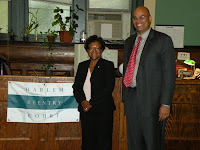
Chairman Yolette C. Ross of the New Jersey State Parole Board visited the Harlem Community Justice Center's Parole Reentry Court this week. Chairman Ross, pictured here with Justice Center Director Chris Watler, is seeking to improve outcomes for parolees in her New Jersey. Begun in 2001, the Reentry Court, a collaboration between the Justice Center and the State Division of Parole, manages parolees during their first six months of parole. Reentry Court participation has led to lower rates of recidivism and technical violations for graduates of the six-month program. Through a collaborative case management approach the Reentry Court increases accountability while providing wrap-around services to parolees. An evaluation of the Reentry Court is currently underway with results expected in the fall of 2009.